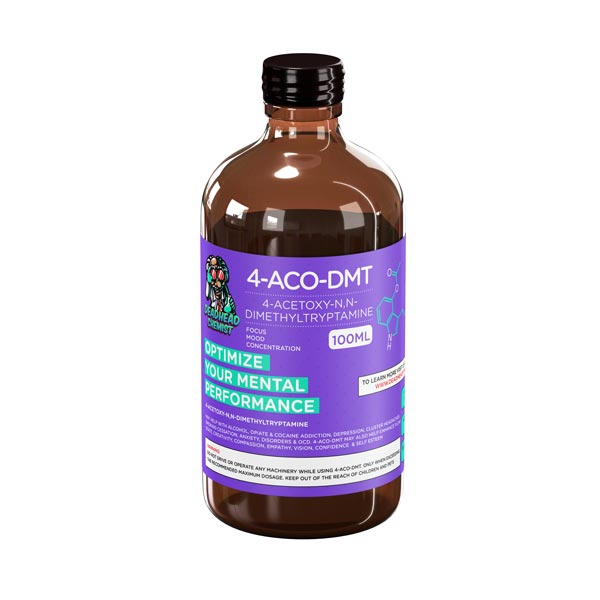
Deadhead Chemist 4-ACO-DMT
Deadhead Chemist 4-ACO-DMT has emerged as one of the most talked-about psychedelic products in the microdosing and psychonaut communities. Whether you’re exploring it for its potential cognitive benefits, its relationship to psilocybin, or simply researching what it is, this comprehensive guide covers everything — from its chemistry and history to effects, dosing, and safety considerations.
What Is Deadhead Chemist 4-ACO-DMT?
Deadhead Chemist is a Canadian-based brand known for producing a curated range of psychedelic and cannabis products, with a strong emphasis on quality, purity, and consistency. Their 4-ACO-DMT product is among their most sought-after offerings — a synthesized tryptamine compound that sits at the intersection of research chemistry and psychedelic exploration.
4-ACO-DMT, formally known as 4-Acetoxy-N,N-dimethyltryptamine (also called O-Acetylpsilocin or psilacetin), is a novel psychedelic substance of the tryptamine class. It is structurally related to both psilocybin and psilocin — the active compounds in magic mushrooms — and is widely described as producing effects that closely mirror a psilocybin experience. For this reason, it is sometimes referred to informally as “synthetic mushrooms.”
Deadhead Chemist’s version is available in crystallized or powdered form as well as a liquid microdose solution, making it accessible for both full psychedelic sessions and sub-threshold microdosing protocols.
A Brief History of 4-ACO-DMT
The story of 4-ACO-DMT begins in the early 1960s. It was first synthesized by Albert Hofmann — the Swiss chemist who also discovered LSD and synthesized psilocybin — alongside his colleague Franz Troxler while working at the pharmaceutical company Sandoz. The compound was patented in 1963 as part of a wider investigation into psilocin analogs but was not tested for psychoactivity at the time and was largely forgotten for decades.
It resurfaced in the 1990s as a designer compound in the emerging rave and psychedelic research chemical scene. In 1999, psychedelic scientist David E. Nichols proposed 4-ACO-DMT as a potentially cost-effective and accessible alternative to psilocybin for pharmacological research, noting that it is significantly cheaper and simpler to synthesize. Despite this, no formal clinical trials have been conducted on the compound to date — though it remains widely used among psychonauts and microdosing enthusiasts.
How Does Deadhead Chemist 4-ACO-DMT Work?
4-ACO-DMT is believed to function as a prodrug — meaning it is converted into psilocin by the body after ingestion. This conversion is thought to occur primarily in the liver and gut, after which psilocin binds to serotonin receptors (particularly 5-HT2A receptors) in the brain, producing its characteristic psychedelic effects.
This mechanism closely mirrors how psilocybin works, which is why the two compounds produce such similar subjective experiences. The key difference is that 4-ACO-DMT is synthetic rather than plant-derived, allowing for more precise dosing and a longer shelf life.
Effects of Deadhead Chemist 4-ACO-DMT
The effects of 4-ACO-DMT are considered nearly identical to those of psilocybin mushrooms, with some nuances that users frequently describe as “crisper,” “cleaner,” or “more lucid.” The experience is highly dose-dependent — lower doses resemble a classic mushroom trip, while higher doses begin to take on qualities more reminiscent of DMT.
Commonly reported effects
- Visual: Geometric patterns, color enhancement, and vivid closed-eye visuals
- Cognitive: Enhanced introspection, time distortion, and philosophical thinking
- Emotional: Euphoria, empathy, emotional openness, and connectedness
- Physical: Mild body buzz, heightened sensory perception
- At higher doses: Ego dissolution and experiences described as profoundly mystical
The onset typically begins 20 to 45 minutes after oral ingestion, with peak effects occurring between 1 and 3 hours and a total duration of 4 to 6 hours. Users consistently describe the character of a 4-ACO-DMT experience as warm, gentle, and introspective — closer to a mushroom trip than to the intense, short-lived rush of smoked DMT.
Microdosing with Deadhead Chemist 4-ACO-DMT
One of the primary reasons for the growing popularity of Deadhead Chemist’s 4-ACO-DMT product is its suitability for microdosing — the practice of taking sub-perceptual doses of a psychedelic substance to enhance daily function without triggering a full psychedelic experience.
Microdosing with 4-ACO-DMT is said to offer several subtle but meaningful benefits:
- Enhanced creativity: Many users report increased lateral thinking and creative output
- Improved focus: Easier access to flow states and sustained concentration
- Mood elevation: A more positive emotional baseline and reduced anxiety
- Greater empathy: Improved interpersonal connections and social ease
- Mental clarity: Reduction in mental fog and ruminative thought patterns
Recommended microdosing protocols
The most commonly followed microdosing schedule for 4-ACO-DMT is one dose every three days, allowing the compound to clear the system fully and avoiding the buildup of tolerance. The Stamets Protocol — four days on, three days off — is another popular approach. Microdose amounts typically range from 0.5 mg to 5 mg, with beginners advised to start at the lower end of that spectrum.
Deadhead Chemist’s liquid microdose format is particularly well suited to this practice, as the solution allows for precise, repeatable dosing — a key advantage over loose powder, where even small measurement errors can meaningfully alter the experience.
Safety and Harm Reduction
Based on its structural similarity to psilocybin, 4-ACO-DMT is generally considered physiologically non-toxic and non-addictive. However, there is currently very limited formal safety data specific to this compound, and its long-term effects have not been studied in clinical settings.Deadhead Chemist 4-ACO-DMT
Key harm reduction considerations include:
- Start with a low dose, especially if you are new to tryptamine compounds
- Avoid combining with alcohol (which can amplify nausea and unpredictably alter effects) or benzodiazepines (which can blunt or eliminate the experience)
- Those with a personal or family history of psychosis or schizophrenia should avoid psychedelic compounds entirely
- Always ensure you are in a safe, comfortable environment with a trusted person nearby for higher-dose sessions
- Use a precise milligram scale — even small variations in dose can significantly change the nature of the experience
Legal Status of 4-ACO-DMT
The legal status of 4-ACO-DMT varies widely around the world. In the United States, it is not explicitly scheduled under federal law but may be considered a Schedule I analog under the Federal Analogue Act due to its structural similarity to psilocin. In Canada — where Deadhead Chemist is based — it occupies a regulatory gray area. In the United Kingdom and Australia, it is explicitly controlled.Deadhead Chemist 4-ACO-DMT
As with all psychedelic compounds, it is essential to thoroughly research the laws governing your specific location before purchasing, possessing, or using 4-ACO-DMT in any form.
Frequently Asked Questions
What makes Deadhead Chemist 4-ACO-DMT different from regular psilocybin?
While the effects are considered nearly identical, 4-ACO-DMT is a fully synthesized compound — meaning it offers more consistent potency, precise dosing, and a longer shelf life than dried mushrooms. Many users describe the experience as slightly crisper and more lucid than a mushroom trip.
How long does a Deadhead Chemist 4-ACO-DMT experience last?
A full-dose experience typically lasts 4 to 6 hours, with onset around 20–45 minutes after ingestion and peak effects between 1 and 3 hours. Microdoses produce no perceptible trip but may offer subtle cognitive and mood effects lasting several hours.
What is the best dose for a first-time 4-ACO-DMT experience?
For first-time users, a low to moderate dose of 10–15 mg is commonly recommended. This range typically produces a manageable, mushroom-like experience without the intensity associated with higher doses (25 mg and above).Deadhead Chemist 4-ACO-DMT
Is Deadhead Chemist a legitimate brand?
Deadhead Chemist is a well-established Canadian brand with a significant online presence and a loyal customer base. They are known for emphasizing product quality and consistency. As with any psychedelic vendor, buyers should exercise due diligence and be aware of the legal status of products in their region.
Can 4-ACO-DMT be used for microdosing?
Yes — microdosing is one of the most popular applications for Deadhead Chemist’s 4-ACO-DMT product. At sub-perceptual doses (0.5–5 mg), users report improvements in creativity, mood, focus, and emotional resilience without experiencing a full psychedelic trip.
| Fitting | Max. 40 Watt |
|---|---|
| Wattage | 4 x 6 Watt |
Related products